

How To Install 2000 Watt Power Inverter
Introduction
The success of a DC to AC ability inverter installation depends mainly on the methods and materials used for the installation. Low DC input voltage inverters (12 or 24 Volts DC) require high DC input currents. For example, to provide a service of 15 Amperes at 120 Volts AC (1800 Watts) from a 12 Volt bombardment, the DC current will approach 180 Amperes! How tin can we supply such a loftier current to the inverter safely and efficiently? This article will guide you lot through a successful power inverter installation.
We are beginning with the assumption that the primary three organisation components - inverter, bombardment, and alternator - take all been called. While installing and wiring these components we will follow the standards and recommended practices described by the:
- National Burn down and Protection Association (NFPA)
- National Electrical Lawmaking Handbook- NEC 96
- Society of Automotive Engineers (SAE)
- SAE Handbook Volumes 1-4
Inverter Installations
Using the Existing Alternator and Battery, what are the organisation limits for a practical inverter installation using the existing nether-the-hood alternator and battery? A majority of utility vehicles accept a 100 to 130 Ampere alternator together with one or two group-27 batteries. Although the alternator cannot go on upwards with a continuous total-load current demand of more than 50 Amperes, it tin can provide enough for brusque term power apply. In many cases the apply of electrical power to practice work is intermittent (using tools off and on for short periods of fourth dimension). In these cases the alternator is able to "keep up" with power use and recharge the battery. There have been many successful installations of a 2300 Watt inverter in such trucks.
Other successful, smaller installations consist of an 1100 Watt inverter system in a smaller utility van or truck:
- Alternator rated at least 85 Amperes.
- A deep-bike bombardment, Group 27 or larger in size.
- Wire from the inverter to the battery is two gauge at up to 15 anxiety (one way distance)
Where larger inverters than these are used, or where more continuous power is required, it is recommended that a battery pack be installed as close equally possible to the inverter and that the alternator system be upgraded.
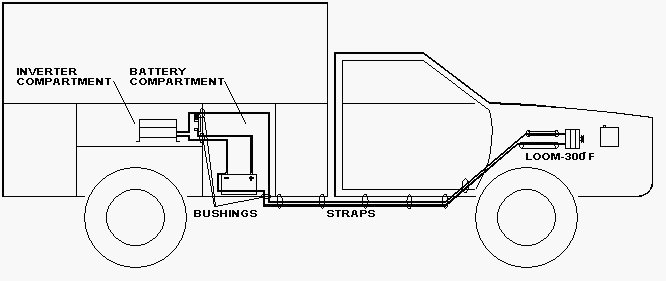
Inverter Installation (refer to Effigy 1) Compartment:
The power inverter is an electronic device and is therefore somewhat sensitive to external factors. Temperature extremes, moisture, and air-borne contagion which volition be drawn into the housing whenever the cooling fan runs - can shorten life. Some areas to avoid mounting the inverter are under-the-hood, on the floor over the frazzle system, or in sealed areas where moisture could condense. The ideal inverter compartment should be a make clean, dry, absurd compartment with some ventilation. Note that the inverter cannot share an area where combustible fuel vapors be because switching components could cause ignition. Corrosive battery fumes should also not be nowadays.
Mounting the Inverter:
Bolt the inverter deeply on either a platform or bulkhead. Exit at least one inch of infinite all around the cabinet and especially above the cabinet for warm air to movement out. The inverter face and the side where large DC cables enter should be visible and accessible for ease of wiring, footing error interrupter testing and status lights viewing.
Fuse Holder Installation:
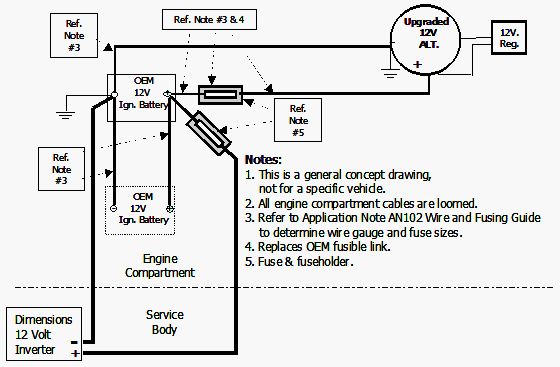
All wiring from a battery must exist protected with the proper size fuses. All fuses and fuse holders should be located within 18 inches of the battery (Figures 2 through 5). Additional fuse holders may be required if the inverter is connected to the engine battery instead of the alternator, or if the under-the-hood wiring is upgraded. The auxiliary battery fuse protects the wires to the inverter and the wires to the alternator. Some other fuse holder must exist mounted at the engine bombardment if a directly connection is fabricated. These auxiliary bombardment fuse holders must not exist installed in an airtight battery compartment because of the explosion hazard mentioned earlier. Mountain the fuse holders in a user-friendly place within 18 inches of the battery and characterization the fuse rating adjacent to its holder. Do not place the fuses into the fuse holders until all wiring has been completed.
Bombardment Installation Compartment:
The battery area must be vapor-tight to the interior of the vehicle and vented directly to the exterior. It must be causeless that hydrogen gas is continuously evolving from the battery. This gas is lighter than air and will quickly escape through openings at the summit of the compartment. Openings at the lesser of the compartment will let in replacement fresh air. Install several vent-plugs inside i inch of both acme and bottom of this surface area. Note that the battery cannot share an airtight expanse containing spark-producing equipment, such as the inverter or fuses which could ignite the hydrogen gas.
Mounting the Battery:
Mountain the Bombardment using concur-downs, trays, or boxes. Secure to a level, clean surface. Bombardment boxes must be of the vented type to let for the escape of gases. Allow space around the bombardment and especially above the bombardment for ventilation, inspection, and maintenance. The battery should not move more than than 1 inch in any management, even if upside-down. A framework of angle iron, together with a protective cover, tin can be made for big systems.
DC Wiring:
1. Employ SGX cablevision
- SGX cantankerous-linked polyurethane cable complies with SAE J-1127 and vehicle manufacturer requirements.
- SGX insulation meets the high temperature requirements (125°C.) of J-1127.
- Refer to AN102 to determine the proper guess cable and fusing for your application.
- Sensata can supply complete cable assemblies with fuse and fuse holders.
2. Cabling diagrams
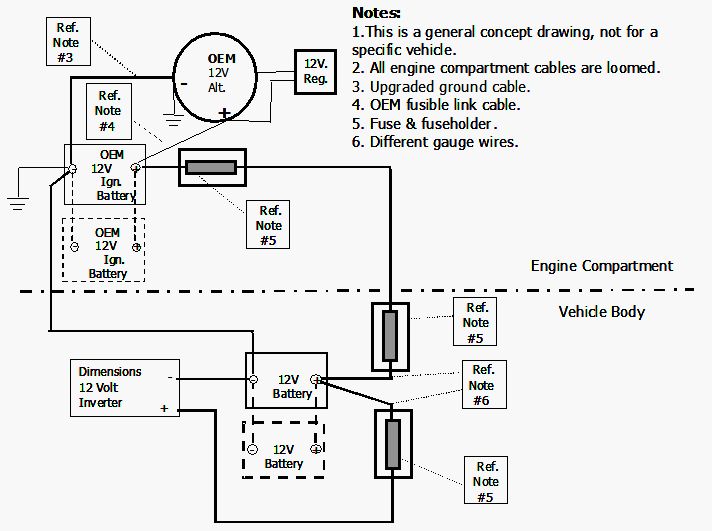
- Figure 2 and 3 are diagrams for a smaller inverter (grand Watt or less) where no auxiliary battery is beingness installed.
- Figure four is a diagram for a larger inverter (chiliad Watt or more) where ane or more auxiliary batteries are being installed.
- Figure 5 is a diagram for a larger inverter where one or more than auxiliary batteries are existence installed and cabling is to the OEM battery.
iii. Routing the cables
Refer to Effigy 1. Run both charging cables straight to the alternator. Do not apply the vehicle chassis every bit a conductor.
- When going through a sectionalization, use a protective rubber grommet to prevent chafe of the insulation. Seal the excess opening with caulk to prevent smoke entry.
- When routing under the vehicle, secure the cables with clamps every eighteen inches, to prevent a snag. Keep the cables away from the bulldoze shaft, exhaust system, and fuel line.
- When routing in the engine compartment, utilize high temperature (300°C.) loom and route the coolest fashion possible.
AC Wiring:
AC wiring must be stranded copper conductors for vibration resistance and must also be protected past a conduit. Road closely to the frame. Employ electrical tape over the wire basics at the terminations because they can exist loosened by vibration.
ane. Use "Boat and Truck Cablevision" for up to x AWGUL listed, meets DOT specifications
- Stranded copper
- sixteen to 10 AWG
- Nonmetallic
2. Apply Type NM-B cable or Individual Edifice Wire conductors to a higher place 10AWG
- UL listed
- Stranded copper
- Nonmetallic
three. Use conduit
- Metallic: utilise rigid Electrical Metallic Tubing
- Nonmetallic: employ rigid PVC
4. Utilise junction and outlet boxes that match the selected conduit organization
five. Bonding Connect a # viii estimate stranded copper wire from the bonding lug on the inverter chassis to the vehicle chassis. The connections must be tight against bare metal. Use star washers to penetrate paint and corrosion. This safety requirement also reduces radio interference (the Dimensions Inverter is UL listed, its DC input connections are isolated from the chassis).
Figure 1 Cablevision Routing for Inverter Installation:
Guidelines for Fusing between Inverter, Batteries, and Alternator
All fuses within 18" of battery - Ref: 1996 NEC commodity 551-x (due east)-(iv)
Effigy 2 Inverter Cabling Diagram (thousand watts or less), no auxilliary battery(southward), OEM alternator:
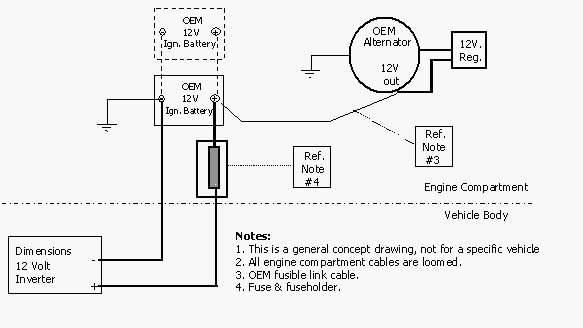
Figure 3 Inverter Cabling Diagram (1000 watts or less), no auxilliary battery(south), upgraded high output alternator:
Effigy 4 Inverter Cabling Diagram (chiliad watts or less), with auxiliary battery(south) (preferred method)
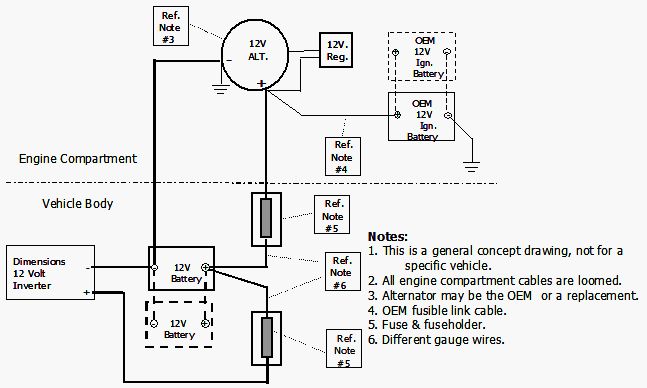
Figure 5 Inverter Cabling Diagram (one thousand watts or less), with auxiliary battery(southward)
DC WIRING
Terminating the cable:
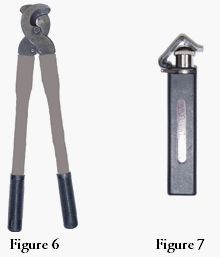
Cut the cable using a shear-type cable cutting tool (figure 6). Strip the insulation from the cablevision using a rotary type cable stripper tool (figure 7).
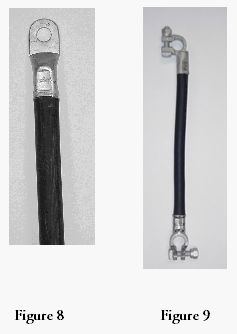
Battery connections can be fabricated with band (figure 8) or clamp (figure 9) terminals. Make alternator connections with ring terminals. Use 5/16" band terminals for the fuseholder connections.
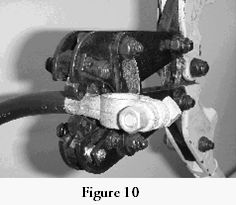
Crimp terminals using a long-handle multi-die crimping tool (figure x).
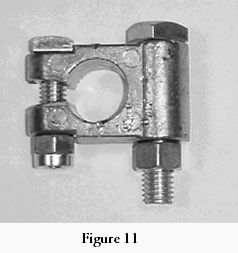
When ii cables must be continued to a single battery post, use a mail service clench blazon last (effigy 11).
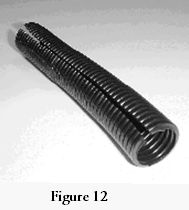
All engine compartment wiring and cabling must be in loftier temperture (300 degrees C) loom (figure 12).

Source: https://www.magnum-dimensions.com/knowledge/installation/power-inverter-installation
Posted by: sawyerthicale.blogspot.com
0 Response to "How To Install 2000 Watt Power Inverter"
Post a Comment